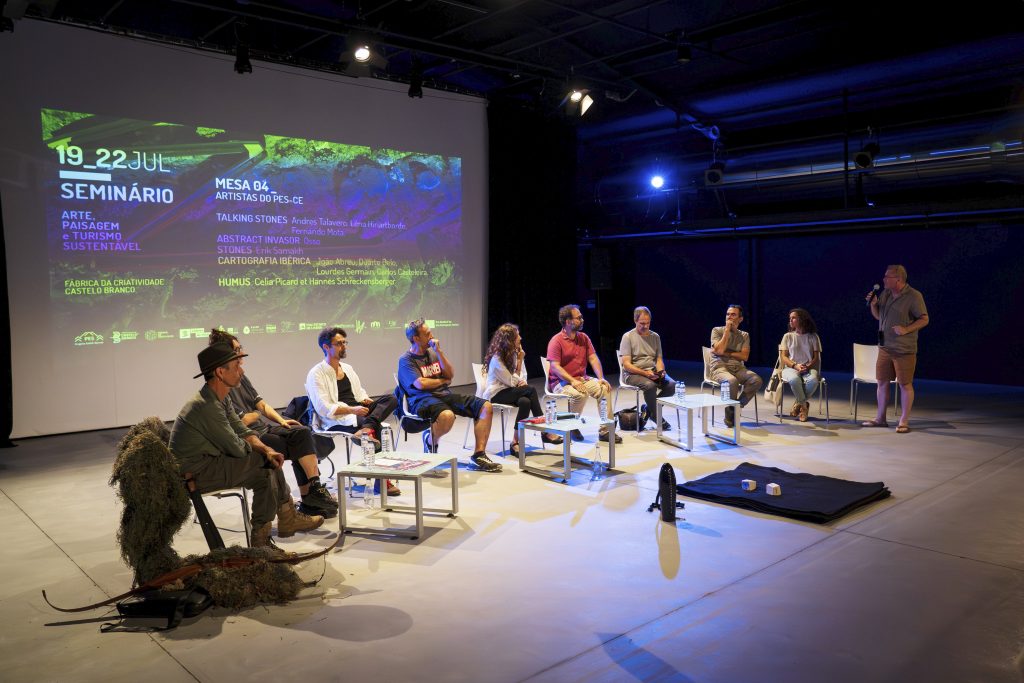
The Seminar “Art, Landscape and Sustainable Tourism” took place from 19 to 22 July 2024 at Fábrica da Criatividade, in Castelo Branco (Portugal).
The first PES_CE seminar explored how art can contribute to sustainable tourism in sparsely populated regions, supporting the vitality of local communities. Representatives from PES_CE partners and invited guests were organised into three panels. Through art, these entities are helping transform the inland and mountain landscapes of Portugal, Spain, and France into cultural tourism destinations and key drivers of local economic development.
Panel 1 – “Art and Tourism to Inhabit the Territory” – addressed how art can build bridges between rural and urban communities, and how artistic initiatives can engage local populations while creating potential tourist attractions. This panel featured Alfredo Aguilera, Mayor of Malpartida de Cáceres (Spain), presenting the Centro de Vías Pecuarias; Bruno Ramos, who spoke about the experience of Aldeias do Xisto; Célia Gonçalves, who presented the Mountain Villages; and Oscar Silva, from Terceira Pessoa (Portugal), who discussed the work of a local artistic association with rural communities.
Panel 2 – “Art for an Immersive Landscape Tourism” – focused on how art can open doors to a more sensitive understanding of the territory. The panel opened with Barbara Sartre, Director of the Aix-en-Provence School of Art (France), who provided an overview of the role of art in shaping knowledge and perception of the landscape. Emanuel Castro, Executive Coordinator of AGE, presented the example of geoparks, where artists engage with the territory through geology, astronomy, and traditional human practices such as shepherding. David Caetano, from Caminheiros da Gardunha, explained how art can enrich the activities of a local hiking association, linking artistic practice with science and discovery. Finally, José Alberto Ferreira presented the Festival Escrita na Paisagem and the success of its artistic immersions in the territory.
Panel 3 – “Art Centres and Museums Far from Large Urban Centres, as Drivers of Mobility and Tourist Attraction” – examined how art itself can serve as a cultural tourism hub, particularly museums focused on rural life and biodiversity. The Spanish perspective was presented by José António Agúndez, Director of Museo Vostell Malpartida de Cáceres, and María Jesús Ávila Corchero, former Director of Museo Helga de Alvear. The French experience was presented by Charles Garcin, Artistic Director of CAIRN, a French art centre connected to two regional museums in Digne-les-Bains, promoting cultural tourism in the Alps. Teresa Ferreira, Director for Tourism at Portugal’s national tourism agency, discussed how art has been integrated into Portuguese tourism policies, while Rui Pelejão, journalist at the regional newspaper Jornal do Fundão, addressed the role of the media in supporting and promoting art initiatives within the tourism sector.